
Arrest Records in Jefferson County
An arrest record documents that a person was taken into custody. In Jefferson County, an arrest by Louisville Metro Police, the Sheriff's Office, or another agency usually ends with booking at the Louisville Metro Department of Corrections at 400 S. Sixth St. The booking record lists the name, a custody identification number, the booking date, the charges, the bond amount, and the next court date. Over the past five years, the department reports more than 30,000 bookings.
It helps to keep arrest records and criminal records apart. The arrest record is the jail's snapshot of a booking. The criminal record is the court's running history of the case. A single arrest may lead to charges that are later dropped, amended, or never indicted. For the full case story, follow the matter into Jefferson County court records rather than stopping at the booking.
Recent arrests show up on the jail roster first. Older arrests are best traced through the court file or a statewide criminal history report.
How to Search Jefferson County Arrest Records
There is no single button that returns every arrest detail, so most searches combine two or three tools. The jail roster covers current custody. The courts cover charges and outcomes. The state covers a person's criminal history. Work through them in order.
- Search Louisville Metro current inmates for a recent booking, name, charges, and bond.
- Note the custody identification number, booking date, and listed charges.
- For the full case, search court records through KYeCourts public case access.
- For a statewide history, order a Kentucky criminal record report through the state system.
- For the arrest report itself, file an open records request with the arresting agency.
See Jefferson County inmate records for the full roster fields and how the current inmate search works.
Recent Arrests and the Booking Process
An arrest record begins at intake. After an arrest, the arresting agency transports the person to the Louisville Metro Department of Corrections for booking. Intake generally includes identification, property handling, a classification review, a medical and mental-health screening, and entry of the charges. The jail assigns a custody identification number, sets the booking record, and schedules the first court appearance.
Bond and the first appearance follow quickly. The District Criminal and Traffic division provides bench clerks for in-custody arraignment and accepts bonds around the clock, except property bonds, which run Monday through Friday from 7:30 a.m. to 4 p.m. Surety bonds can be posted any time and carry a $25 filing fee. A booking that lists a next court date tells you the case has already moved into the District Court system, where the early hearings happen.
Because the jail roster updates as people are booked and released, a name may appear within hours of an arrest and drop off after release. For a person no longer in custody, the court file and a statewide history report are the better trail.
How to Request a Jefferson County Arrest Report
The booking record is not the same as the arrest report. The arrest or incident report is written by the arresting agency, such as Louisville Metro Police or the Jefferson County Sheriff's Office. To get it, you file an open records request with that agency under the Kentucky Open Records Act. The right of inspection sits in KRS 61.872, and agencies must respond within the statutory time.
The Sheriff's Office, for example, asks for a written request to its records custodian, advises applicants within five working days, and charges $0.10 per page for written material. Active investigation files and certain law-enforcement records may be withheld while a case is open. For court outcomes rather than the police narrative, the case file at the Office of Circuit Court Clerk is the source.
Arrest Records vs. Criminal Court Records
These two records answer different questions. An arrest record says a booking happened. A criminal court record says what the court did about it. The table below sets them side by side.
| Point | Arrest Record | Criminal Court Record |
|---|---|---|
| Source | Louisville Metro Corrections jail booking | Office of Circuit Court Clerk case file |
| Shows | Booking, charges, bond, court date | Filings, pleas, orders, disposition |
| Proves guilt? | No | Only a conviction does |
| Best tool | Current inmate search | KYeCourts public case access |
When the two records seem to disagree, the court file is the one that tracks the final result.
Charges vs. Convictions
A charge is an accusation. A conviction is a finding of guilt. The gap between them matters for anyone reading an arrest record. Many charges end in dismissal, amendment, or acquittal, and none of those is a conviction.
| Point | Charge | Conviction |
|---|---|---|
| Meaning | An offense alleged at arrest or filing | A guilty finding or plea entered by the court |
| Where it appears | Booking and early case entries | The disposition and judgment |
| Can it change? | Yes; charges are often amended or dropped | Stands unless vacated or expunged |
Read the disposition before you draw any conclusion from a charge listed at booking.
Sealed vs. Expunged Records
Kentucky lets some records be cleared or hidden. Sealing limits public access to a record that still exists. Expungement goes further: it vacates the judgment and dismisses the charges, and agencies, including law enforcement, expunge their copies. The expungement of dismissed charges under KRS 431.076 is one of the more common paths.
| Point | Sealed | Expunged |
|---|---|---|
| Record still exists? | Yes, but access is restricted | The judgment is vacated and charges dismissed |
| Who can see it? | Parties, counsel, or court-authorized persons | Limited law-enforcement retention only |
| Public search result | Hidden from ordinary search | Removed from public records |
For conviction expungement, Kentucky requires a certificate of eligibility before a petition is filed. The Kentucky Court of Justice expungement page explains the certification step.
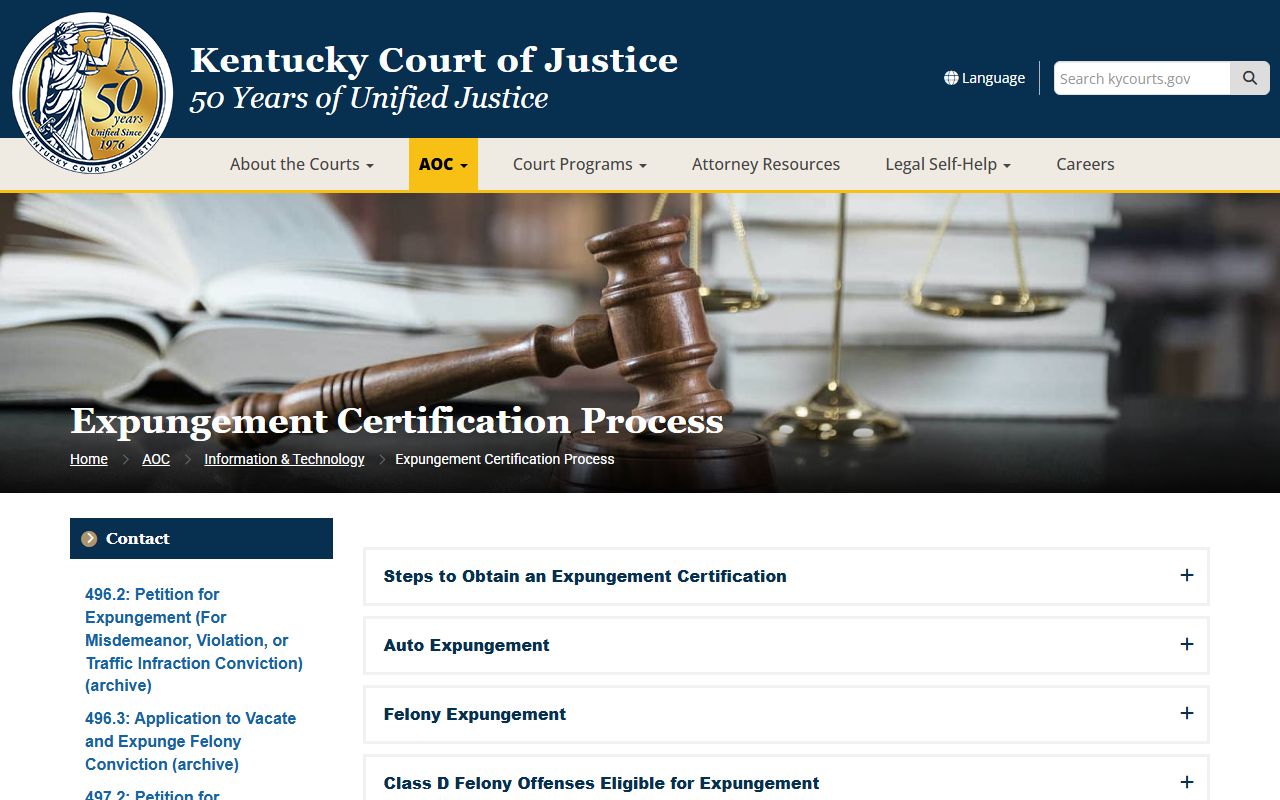
Most Class D felony convictions became eligible under changes effective in 2019, though a felony petition cannot be filed sooner than five years after the sentence is complete. Locally, the Office of Circuit Court Clerk handles expungement petitions and orders, and guilty-conviction petitioners pay a $100 fee per case.
Mugshots and Booking Photos
Booking photos are part of the intake process, but their public availability is not guaranteed. The official Louisville Metro Corrections current-inmate page describes the name, custody number, booking date, charges, bond, and next court date without confirming a public mugshot display. The Kentucky Online Offender Lookup, run by the state Department of Corrections, says most state offenders have photos, though it offers no guarantee.
Be cautious with mugshot websites that are not government sources. Many are private aggregators, and the official path runs through the jail and the state corrections system, not third-party sites. If you need to confirm whether a photo is tied to a real case, match it against the jail roster or the court file rather than trusting an unofficial image. A booking photo, even when public, only shows the arrest, not whether the case ended in a conviction.
Statewide Criminal Records Search
An arrest in Jefferson County is only part of a person's history. For a statewide view, Kentucky offers a criminal record report through the state court system, and the KYeCourts guest page links that report alongside public case access. The Kentucky State Police also handles criminal history and the certification used in expungements.
The Kentucky State Police expungements page ties together the statutes that govern clearing a record, including KRS 431.073, 431.076, 431.078, and 431.079.
For someone sentenced to state prison, the state offender lookup adds custody and supervision detail beyond the county jail roster.
Background Check Considerations
Arrest records often surface in background checks, but how they may be used is limited by law. An arrest without a conviction is not the same as a criminal history, and sealed or expunged matters should not appear in a lawful report. For employment, housing, or licensing, official sources and a proper background check process apply.
Note: This site is not a consumer reporting agency, and its information cannot be used for credit, employment, tenant, or other purposes regulated by the Fair Credit Reporting Act.
Restricted Criminal Records in Jefferson County
Some arrest and criminal records stay closed. Juvenile records are confidential under KRS 610.340, and the Jefferson Juvenile Division releases information only to the child, a parent, the victim, or a court-authorized person with a photo ID. Mental health matters are also confidential, and the division bars photos and recordings. Records from confidential cases require party or attorney status under a court order.
DUI and DWI arrests deserve special care, since they create criminal cases rather than simple traffic tickets. Those matters can involve arraignment, bond, license consequences, and treatment, so they belong with criminal and traffic court records rather than a routine citation lookup.